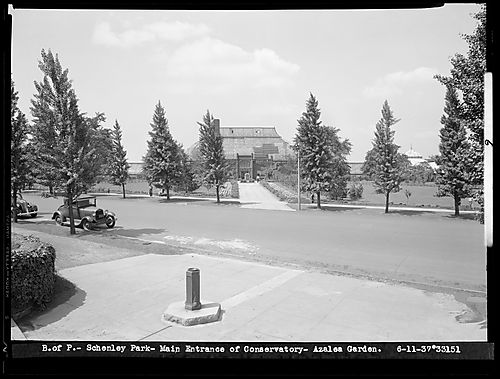

Phipps Conservatory. 715.3733151.CP. Historic Pittsburgh. Site.
Henry Phipps the Philanthropist
Henry Phipps was an extremely successful entrepreneur and industrialist. He started out with very little, and worked as a jeweler’s apprentice and an errand boy in his youth. He became very wealthy during his lifetime through some well-made investments, and Phipps believed that when people are successful, they should give back to the community. This way of thinking was extremely different from that of Henry Clay Frick and Andrew Carnegie, who were content to see their money grow, and weren’t philanthropic until the end of their lives, when they began to feel guilty for past misdeeds. Phipps, however, was philanthropic all throughout his life. In Meet You In Hell, Phipps is described as “the possessor of a keen financial mind, but he had neither the will nor the temperament of a leader” (Standiford 68). Frick and Carnegie were leaders, but Phipps was a much better person.
According to Martin Wooster, Phipps “built extensive public parks and conservatories throughout his hometown of Pittsburgh. He funded research into the treatment, prevention, and cure of tuberculosis, an effort which led him to create reduced-cost housing for the working poor. Perhaps most notably, he funded the creation of the country’s first medical faculty in the field of psychiatry” (Wooster 1). He is said to have donated the majority of his money to charity, but nobody will ever know exactly how much. His granddaughter states, “Unlike Carnegie, Harry shunned all publicity about his personal life and philanthropies” (Wooster 1). He was a very private person, and frequently declined interview requests with reporters in order to keep his personal life, business dealings, and philanthropic efforts as private as possible.
Andrew Carnegie especially approved of Phipps Conservatory and Botanical Gardens. He wrote in The Gospel of Wealth, “I think Mr. Phipps put his money to better use in giving the working-men of Allegheny conservatories filled with beautiful flowers, orchids, and aquatic plants, which they, with their wives and children, can enjoy in their spare hours, and upon which they can feed their love for the beautiful, than if he had given his surplus money to furnish them with bread” (Wooster 1). Plants, flowers, and family time provide much more happiness and joy than food ever could.
His biggest act of philanthropy was the creation of the Phipps Conservatory and Botanical Gardens. His conservatory was considered a donation from Phipps to the working-class people of Pittsburgh, because entering the institution was completely free. Phipps primary reason for creating the gardens was “to erect something that [would] prove to be a source of instruction as well as pleasure to the people” (Harkins 1). He knew that most working-class people lived in row houses and did not have any room for gardens, and would appreciate the idea of seeing flowers and other types of plants free of charge.
The Phipps Conservatory was built in 1893, and was an initial success. It was stated that “The Conservatory was designed by the famous Lord & Burnham firm in New York and cost $100,000. He also insisted on the building being open on Sundays so that the workers who worked on Saturdays could visit with their families on their days off. Admission was free until 1940” (“Phipps…” 1). It kept running smoothly until Henry Phipps died in 1930. After Phipps’ death, the Conservatory was neglected until 1935. It was almost closed, but instead kept open and every visitor was required to pay twenty-five cents to attend. Phipps never wanted to charge anyone to attend, but it became necessary in order to keep the Conservatory up and running.
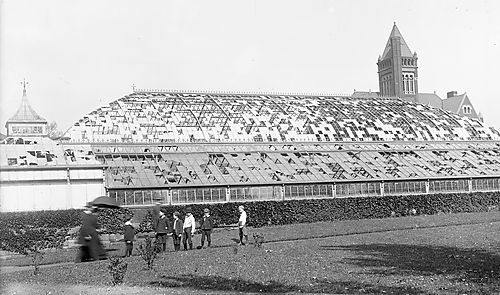
In 1937, a windstorm damaged the plant houses and forced Phipps to close for two years while it was repaired. The time was also used to make the Conservatory larger. The greenhouses were just as sustainable and good for the environment as ever, but were one-third larger, and added central garden pieces for each room. It was after these renovations took place that it started to look like the Conservatory of today.
In Thomas Sweterlitsch’s Tomorrow and Tomorrow, Dominic remembers how his wife Theresa “chatted about sustainable horticulture and a set of adult classes she’d received grant funding to offer at the Conservatory-a community garden project she was eager to start in East Liberty, a greening initiative” (Sweterlitsch 73). Theresa is from Thomas Sweterlitsch’s vision of the future, and in his mind, the Botanical Gardens and the Center for Sustainability are still open and thriving. Henry Phipps’ Conservatory seemed to be doing so well that Theresa was even planning on starting a whole new project.
Phipps was the first person to create a sustainable building, so he is now not just known as an industrialist and a philanthropist, but also an innovator. Greenhouses are sustainable because they are entirely made out of glass, which allows heat to escape easily. The windows are also always open to allow natural daylight to filter in and provide light for the flowers and plants.
Phipps’ sustainability project is still going strong, and the Center for Sustainable Landscapes was added in 2006. Harkins mentioned that “The Pittsburgh Post-Gazette calls this addition “the greenest of its kind” due to its success in meeting the world’s most demanding green building standards” (Harkins 1). On Phipps official website it is written that “The Center for Sustainable Landscapes (CSL) at Phipps Conservatory and Botanical Gardens generates all of its own energy and treats all storm and sanitary water captured on-site. It is the first and only building to meet four of the highest green certifications: Living Building Challenge, LEED® Platinum, Four Stars Sustainable SITES Initiative™ (SITES™), and the WELL Building Platinum project” (“Center for…” 1). Phipps probably never expected his donation to the city of Pittsburgh to be this successful. He had only intended the Conservatory to be for poor people, but he would probably be pleased to know that poor, middle-class, and wealthy people alike all have the opportunity to enjoy his Conservatory, and that his creation is still being enjoyed to this day. Phipps’ donation has gone a long way. His creation is still contributing to environmental sustainability, and helping to green the city of Pittsburgh, and it will continue for years to come.
Works Cited
“Center for Sustainable Landscapes.” Accessed 25 November 2017.
Harkins, Nicole. “Phipps Conservatory: A Revolutionary Greenhouse.” Phipps Conservatory, 2014.
“Phipps Conservatory.” Tanglewood Conservatories, 2017. Accessed 25 November 2017.
Standiford, Les. Meet You In Hell: Andrew Carnegie, Henry Clay Frick, and the Bitter Partnership That Transformed America. Three Rivers Press, 2005. Print.
Sweterlitsch, Thomas. Tomorrow and Tomorrow. Penguin Random House, 2014. Print.
Wooster, Martin Morse. “Henry Phipps Jr.” Accessed 25 November 2017.