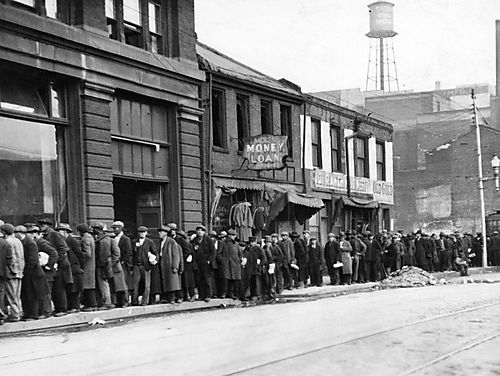
Archival photograph of one of the many enormous bread lines during the Great Depression era of Pittsburgh and America. A "Money Loan" sign can be seen in the photo.
Pittsburgh Creative Reuse Culture: Large and Small Scale
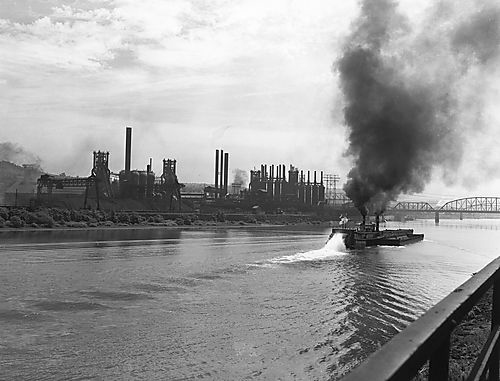
A quick walk through the Pittsburgh Center for Creative Reuse and the theme is evident. Stacks of old participation trophies, buckets of beads, and rolls of gaudy wallpaper would seem like junk to most sane people, but here they bring infinite opportunities to create. This creative reuse culture seen at the PCCR has been cultivated by the oscillatory nature of our city. The humble beginnings of Pittsburgh started with a massive influx of immigrants, largely from Eastern Europe, motivated by the industrial job opportunities present. Here the importance of hard work was beaten into each newcomer by business tycoons known for their “chicanery, dishonesty, infidelity to associates, avarice, and double-dealing” (Standiford 283). These dominant figures, like Andrew Carnegie and Henry Clay Frick, built the booming 20th century American economy, as well as the Empire State Building and the U.S.S. Missouri battleship with iron produced at the Carrie Furnaces of the colossal Homestead Steel Works (Hopey). Despite this success, being “The Steel City” came at a cost for thousands of millworkers. Their “hard, exhausting and always dangerous” work reduced employees to “human flesh and blood” that “could stand no more,” but “got up at five in the morning as usual and put on its work clothes and went into the mill; and when the whistle blew it came home” (Bell 48).
The dependency on industry became Pittsburgh’s downfall during The Great Depression, when demand for steel tanked. Resulting in alarming headlines like “6 Collieries Close as Coal Strike Grows, 22,000 Men Out” and breadlines that went on for blocks. With the help of determined citizens, the city has bounced back and reinvented itself into a city known for die-hard sports fans and a young, innovative crowd. These citizens are no strangers to hard work and epitomize the “hard work, never hurt” attitude of Jim Kapusta, a former millworker at the Carrie Furnaces. This unique history has cultivated a creative reuse culture seen through the proliferation of environmental start-up companies. Although these start-ups do not permeate quite as deeply as the steel industry once did, careful inspection reveals the growing momentum Pittsburgh is gaining through thoughtful sustainability.
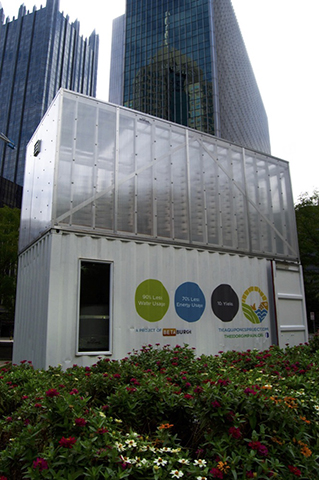
A starting point for many of these grassroots projects is at the University level. Here passionate students are able to build the foundation for a brighter future with the help of non-profits like the Sprout Fund, The Door Campaign, and Betaburgh. These local philanthropic companies offer support for cutting edge projects that take a holistic angle at improving the community. One successful student organization is the Aquaponics Project. Here students from the University of Pittsburgh have taken their first steps in addressing the lack of healthy, affordable food, while also focusing on bringing the “beauty back to farming,” according to Vinh Luong, the former president of the Aquaponics Project. With a detail oriented mindset, the Aquaponics project was able to turn an old shipping container into a sleek aquaponics system that sustainably produces basil and tilapia. Moving forward, co-presidents of The Aquaponics Project, Kareem Rabbat and Kiel Hillock, continue to push boundaries. One key current initiative, summed up by Kareem Rabbat, is fixing “the disconnect with the current food system” by “not only tackling food production with the container, but other aspects of food like food waste.” The plan of action for this lofty goal is to add an anaerobic digester to the aquaponics system, which converts food waste into methane that will sustainably power the container’s pump system.
A close network of do-gooders allows these young entrepreneurs of Pittsburgh to “get things done that are looked on as impossible elsewhere” according to George Swetnam in Where else but Pittsburgh. One important aspect of this culture that is often overlooked is marketing. This is where Sara Innamorato, a “marketing for social good extraordinaire,” steps in. After graduating from the University of Pittsburgh, Sara decided to take on her desire to do good, which had brewing in the back of her head throughout her undergraduate years. This led to a few forays into helping rising non-profits, like GTECH and Pittsburgh Food Council Policy, increase their community impact. Sara quickly came to the conclusion that “all non-profits are terrible at marketing.” The main source of this deficit seems to be that the start-ups are heavily technology oriented. As a result, brilliant engineers with ideas to enhance the creative reuse culture of Pittsburgh are lacking in community support. In order to gather enthusiasm for these sustainability focused non-profits, Sara acts as a translator and liaison for the community. For example, one GTECH initiative Sara worked on involved transforming vacant lots into a community garden. Initial presentations to gather support apparently included an eager engineer talking about how special their soil was for twenty minutes. This attention to detail is important in the planning steps, but bogged down the presentation and ignored the over arching theme to “improve the social, economic and environmental health of the whole community” (GTECH). To effectively translate and market projects to the community Sara immerses herself beyond the scope of marketing, by networking at events in technology, political, business, and more. This allows Sara to understand the community she is working with and empower them to become a part of Pittsburgh’s creative reuse culture.
Recently Pittsburgh’s creative reuse culture has come full circle by reinventing the Carrie Furnaces. This site has gone from a derelict memento of the past to a site for artistic inspiration and community engagement. The revival of the furnace began with the illegal construction of the Carrie Deer; a 40-foot deer head sculpture composed of industrial scraps found on site. A team of seven artists began construction in 1997, while “eluding interlopers and authorities by hiking to the site with limited tools and keeping their project hidden from the outside world” (Weaver). This installation, that was “motivated by a sense of commemoration preservation, and transformation,” unintentionally spurred others to explore their own interpretations of the furnace (From the Carrie Furnace). One active organization at this site is the Rivers of Steel and Arts. Their mission is to to “enhance the lives of community members, build local pride and attract renewed public interest” by supporting artistic renewal projects throughout Pittsburgh. The large scale reuse of Carrie Furnaces also includes hosting weddings, festivals, and aluminum casting workshops, which add another layer to the ever growing creative reuse culture of Pittsburgh (About River of Steel Art).