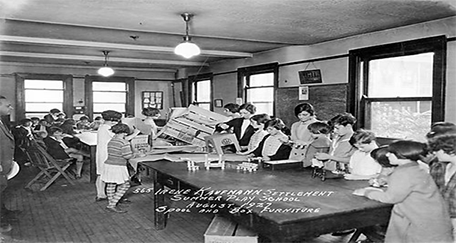

Archival image called “Spool and Box Furniture.” Many children creating model furniture out of refuse at the Irene Kaufmann Settlement Summer Play School in August 1927.
All for Fun, Fun for All
The Pittsburgh Center for Creative Reuse (PCCR) is more than a center for recycling and a place for used goods. It is a resource for the community that provides a creative outlet for children and students. But such resources are typically not available to the elderly communities where such programs could be useful. Community arts and crafts programs provide companionship, dexterity, and stimulation of the imagination. These are just some of the aspects that can be helpful to the senior community. “Questions of education, inclusion, social services, public spaces, digital literacy, social justice, human rights, and other community needs are the defining issues for the present and future of public, school, and academic libraries”, and so too is the PCCR functioning as a miniature community hub that has crossed into some of these defining roles (Jaeger).
Community organizations have provided creative spaces for people to explore and discover. The Irene Kaufmann Settlement House (Fig.1) has provided an open space for children to spend their imagination on craft projects that are tangible and achievable. The original function of the Settlement House was as a transition point for newly arrived immigrants to get accustomed to life in the United States and in the diverse city of Pittsburgh. It grew into a community hub because of the need of the community. The Settlement House methods of integration may have changed; the outcome was still the same. Social interaction can help with the people’s ability to adapt to a new culture perhaps better because of the hands-on nature of play.
The PCCR as a space expands further than the four walls of its bricks and mortar establishment. The travelling nature of its program structure is important to its advocacy and outreach works. The PCCR can spread its art programs benefits by bringing them to locations with high volumes of children like the Carnegie Library, festivals, museums, and schools. Their “professional development programs have focused on creativity and loose-parts play” (PCCR). The work done by the PCCR is functioning to help encourage creativity using the theory of loose parts because “all children love to play, experiment discover and invent and have fun” (Nicholson). An expansion of their programs to target an older demographic would spread these constructive characteristics of creative education to impact more participants. I posit that play is important at all ages; one is never too old to enjoy arts and crafts.
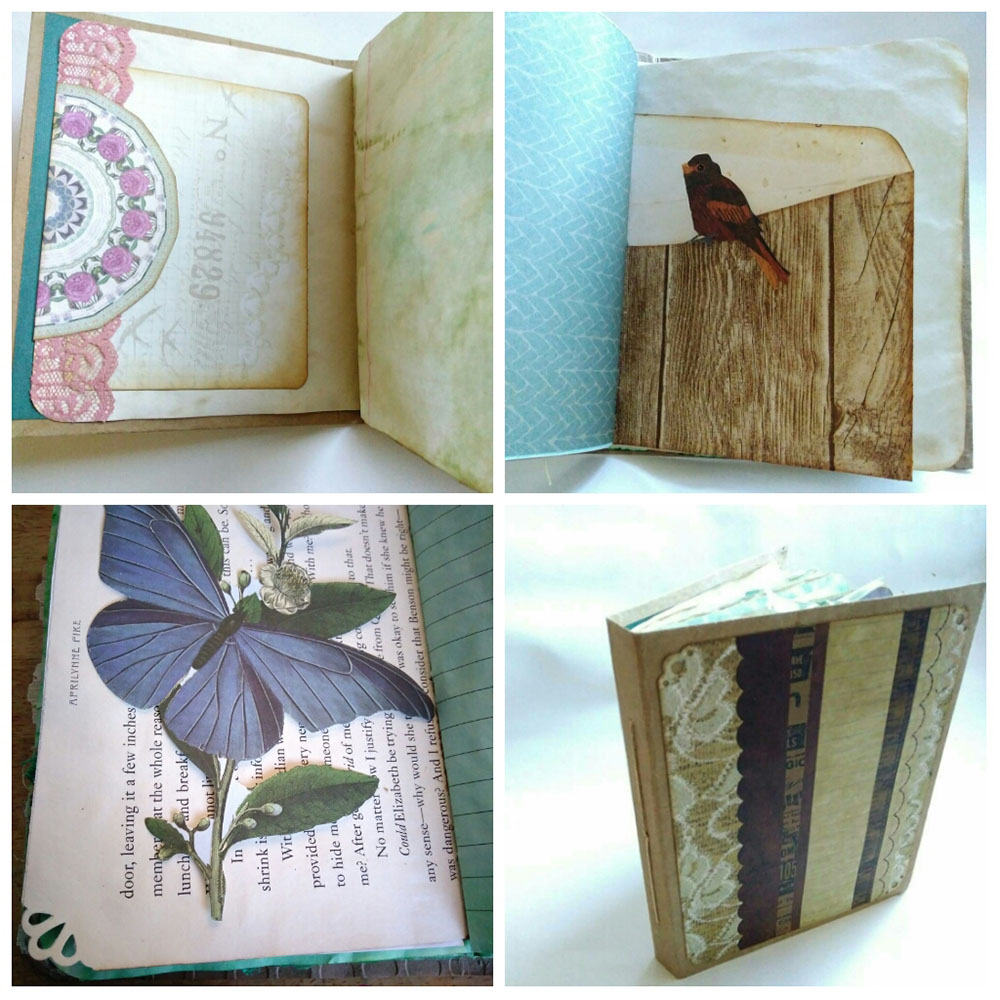
I am a maker. I enjoy creating art out of used objects. I particularly enjoy using paper to make crafts such as scrapbooks and journals. The PCCR has been a treasure trove in my collection of supplies. I search for paper that has a sense of history and inspires questions about its previous use: old books with marginalia, delicately sewn doilies, ledger paper from defunct businesses, and magazines from past decades with product advertisements that I marvel were ever popular are but some of the gems that I have found. The history in these objects combined with the age of the papers transforms my creations into a more meaningful piece that has the role of continuing history. Growing up in the public-school systems where art programs were the first budget cuts has made handcrafting very more important to me. At an age where there is an abundance of stressors juxtaposed to hours of boredom, ‘making’ has become the major relief from both. To design, build, construct, sew and create things with my own hands links me closer to my end products. The work that I do feels like an extension of my imagination because I have been a participant in every aspect of its creation, from conception to completion (Fig. 2).
Community education is a field that I am interested in pursuing upon graduation. Not all education programs have to be about literacy or arithmetic. They can be about having fun or getting messy. It is equally important to know how to share and socialize with peers as it is to be able to read. ‘Making’ provides an opening for many talents and a reemergence of forgotten ones. These program participants can be our next engineers, installation artists, teachers, scientists, or anything that they want to be because it is a “culturally induced and perpetuated lie [that] creativity is for the gifted few” (Nicholson 5). The new maker community can also be our grandmothers, neighbors, mail carriers, empty-nesters, and retirees looking to fill their free hours. I want to offer education in a way that encourages people’s desire for exploration and want of creativity. Imagination shouldn’t be delegated as an object to be outgrown and is quickly shelved as soon as one becomes an adult. Creativity should be nourished all throughout life.
There are other sites that provide a push to the viewer’s imagination. There is an installation piece at the Mattress Factory Museum that was modeled like a cluttered attic which made me want to explore the hidden objects in that chaotic jumble. They followed the loose-parts theory by having little magnifying glasses for viewers to interact with throughout their walkthrough, a path that required you to step up and down, and fiddly bits that you could stop to spin. This type of interactive and imaginative art is appealing and what drew me to the Pittsburgh Center for Creative Reuse. It is a center that encourages customers to examine bottle cap art, immerse yourself into a stranger’s family photos, submerge your hands into the barrels of beads, test your sense of smell with baskets of wine corks (Fig. 3), peer into dark crevices for potential forgotten items, and crouch until your knees crack as you meticulously flip through shelves of books.
The PCCR is arguably a recycling center but it is also a focal point for the creative arts and education. They provide access to a way of thinking that is much needed in the production of fresh minds that looks at waste in a creative way. The idea of creative reuse should be implemented in all aspects of life and during all phases of life. As an adult crafter, I can attest to the benefits of having fun with art. “The need nowadays, to systematize what we adults view as purpose — stems from the fact the adult world has become separated from the world of children” (Bettelheim 1). Creative education programs can help bridge the gap between the generations. Fun should be shared by all.
Works Cited
Bettleheim, Bruno. “Play and Education.” The School Review, vol. 81, no. 1, 1972, pp. 1-13., www.jstor.org/stable/1084035.
Irene Kaufmann Settlement. “Spool and Box Furniture.” University of Pittsburgh. Identifier:7812.6565.IKS. August 1927. Web.
Jaeger, Paul T., et al. “Library Research and What Libraries Actually Do Now: Education, Inclusion, Social Services, Public Spaces, Digital Literacy, Social Justice, Human Rights, and Other Community Needs.” Library Quarterly. 491-93. Print.
Nicholson, Simon. The Theory of Loose Parts: An important principle for design methodology. Open University.
Pittsburgh Center for Creative Reuse. “Creative Education Programs.” Print.