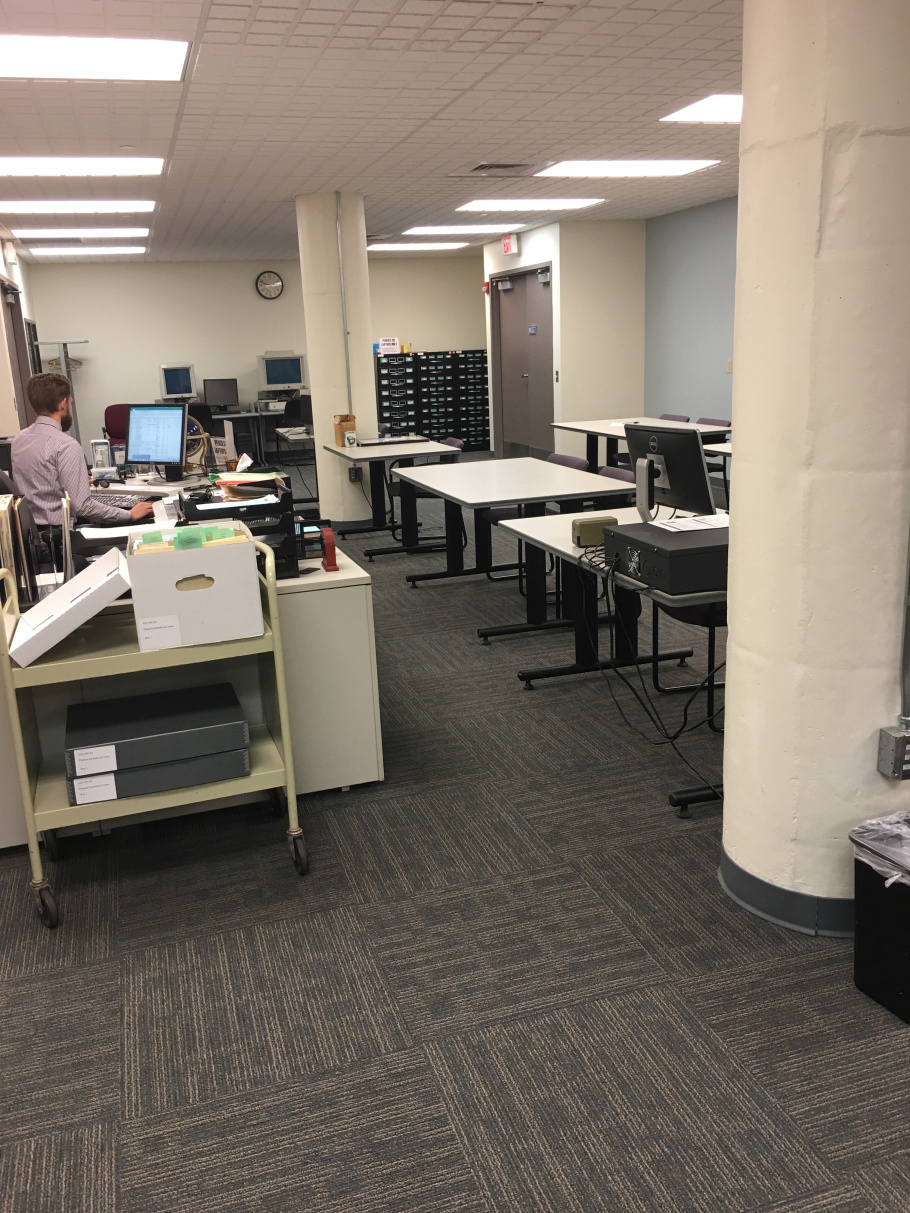
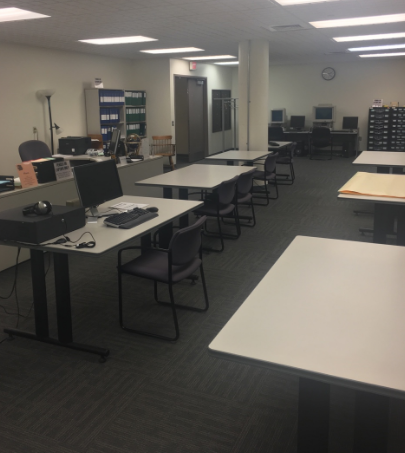
Visitor Center of the Archives Service Center. Photo by Seana Gysling.
My Journey Through the Archives
Before my experience with the Archives Service Center in Pittsburgh, I had never used an archive before. Is the Archives Service Center a large warehouse-like facility with storage rooms of documents, diaries, records, notebooks, and photographs but also a digital space to sift through information? How did the center get all of these resources? What makes something valuable enough to keep in the Archives? Who sorts through and organizes all of the collections?
My first experience with the Archives Service Center was through my English Literature class, Secret Pittsburgh. In this class, we explore less-known spots of Pittsburgh and write guidebook entries about each site. Our class got to experience a guided tour of the Archives Service Center. When exploring the warehouse space of the Archives Service Center, I found a particular document that caught my interest; John Tate’s book on the Harmony Society called “The Harmony Society at Economy Penna.” This book connected with one of my other classes called Cities in Historical Perspective in which we are studying patterns of urbanization, relationships of urban spaces and Utopian societies. The Harmony Society was model society that believed in collectivism. The author, John Tate, was a wealthy man who grew up about 4 miles away from Economy, PA, the home of the Harmony Society. There, he took pictures and observed the society members “work on their farm, the grist mill, cider press and bakery” (Tate). Because of the exclusivity of the Harmony Society, it was rare for a nonmember to know much about the society’s lifestyle. Tate, because of his close connection to the society, was able to compose a scrapbook-like account of the Harmony’s Society culture. He even had the luxury of sending his black and white photos to Japan to have them hand water-colored for his book.
After seeing this book in person and the amazingly intricate watercolor drawings of the society, I wanted to research more into the Harmony Society by examining the digitized version of John Tate’s book on the Archives Service Center website. So I took my search to the digital realm of the Archives Service Center on the Historic Pittsburgh website. The Historic Pittsburgh website was difficult to navigate at first. It searches by tag names which is great for searching board topics such as “Oakland” or “Carnegie” however it was difficult to perform a narrow search. So I took my search to University of Pittsburgh’s Digital Library which allowed me to search in a more focused manner. After typing “John M Tate” into the search bar, I found “The Harmony Society at Economy Penna” as my first result.
After my small victory of finding John Tate’s digitized book, I was rather disappointed to find that the digital book’s pages were discolored. This discoloration of the water-colored photographs took away from the impressiveness and authenticity of the book. However, the Archives Service Center has much more to explore than just the Harmony Society. I decided to take my journey through the Archives in a new direction. Instead I changed my study to look at the life of steel workers during Pittsburgh’s boom of the steel mill industry.
This is where the Historic Pittsburgh Image Collection, a part of the Historic Pittsburgh website that archives digital images, came into great use for me. I was able to search by sub collections within the Historic Pittsburgh Image collection. I started browsing through the sub collections ranging from “Hebrew Institute Photographs” to “Pittsburgh Public Schools Photographs”. The one collection that caught my eye was the “Urban League of Pittsburgh Records” which follows the history of Pittsburgh’s branch of the National Urban League. Pittsburgh’s Urban League was founded in 1910 with an emphasis on “African-American employment and training…” including “federal housing projects, youth employment, worker discrimination and African-American welfare work” (“Urban League”). Still in existence today, the National Urban League is a nationwide organization “dedicated to economic empowerment in order to elevate the standard of living in historically underserved urban communities” (“Who We Are”).
Before diving into the working conditions of black steelworkers in the early 1900s, first I needed to do some background research on African American populations in Pittsburgh as a whole. I used the description section of the Urban League Collection to help narrow my search to a certain time period. After reading the description section, I zoomed in on the African American Great Migration during World War I. Between 1915-1960 about five million African-Americans from the south moved to northern, industrial cities like Detroit, Pittsburgh, and Chicago to find work (Gottlieb). During World War I specifically, about 454,000 African-American workers moved from the South to escape poor economic conditions as well as social oppression in the South (Gottlieb). During this time period, the South experienced a huge economic decline from an insect called boll weevil. The boll weevil insect destroyed a significant amount of the cotton crop in the South causing a decrease in demand for both sharecroppers and tenant farmers. At this time there was also an increased demand for workers in northern industrial cities. Thus, many African Americans moved north in search of a better life. Yet soon the rapid population increase in northern cities lead to competitions for suitable housing among workers.
“However, miserable working conditions in the mills and inferior housing accommodations in Pittsburgh and the surrounding milltowns dashed the hopes of many migrants who thought of the North as a “Promised Land.”” (Dickerson, 41)
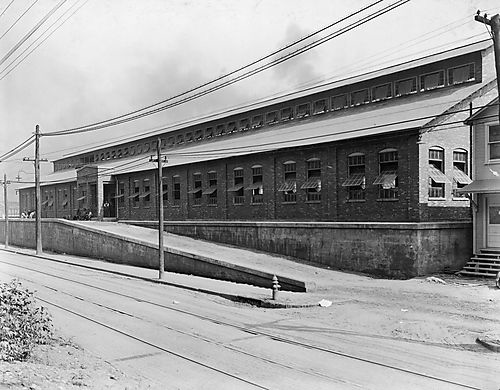
From there I wanted to find specific images to read into the working conditions of African American workers and what was the Urban Leagues role in helping alleviate these conditions. I found this one picture of an African American bunkhouse. The limited description on the Archives Service Center website said that the bunkhouse was located in Braddock, PA, which I knew was famous for being the home of Carnegie’s steel industry. After trying to extract information from the picture with my limited knowledge of the history of black steelworkers and working conditions, I turned to David Grinnell, Expert Reference and Access Archivist at the Archives Service Center, for help in analyzing the photograph. I contacted him through his question and answer communication link on the Archives Service Center webpage inquiring about more information on my specific picture. He quickly got back to me, pointing me towards three different books at the University of Pittsburgh’s Hillman Library. These books were references about black steelworker history and within these references were sections about the living conditions that could help me better understand my picture of the black bunkhouse in Braddock. Unfortunately, David Grinnell did not have any other specific information on the picture but his book recommendations were more than enough to help me gain perspective on the harsh living conditions of the black steelworkers during the Great Migration.
“Kracha worked from six to six, seven days a week, one week on day turn, one week on night. The constant shifting of turns made settlement into an energy-saving routine impossible; just when he was getting used to sleeping at night he had to learn to sleep during the day. At the end of each day-turn week came the long turn of twenty-four hours, when he went into the mill Sunday morning to wash, eat and sleep until five that afternoon, when he got up and returning to the mil to being his night-turn week” (Bell 47)
My journey through the Archives was not a linear one. I started at the Harmony Society and ended up in a black steelworker bunkhouse. Even though I never got specific information on my picture of the Braddock bunkhouse, I still learned a lot about the history of the steelworkers. At first, I was expecting the Archives to provide specific information on each photo but when I discovered that was not the case I was still able to use the photographs, ambiguous or not, to lead me through an interesting research process.
How People Use the Archives
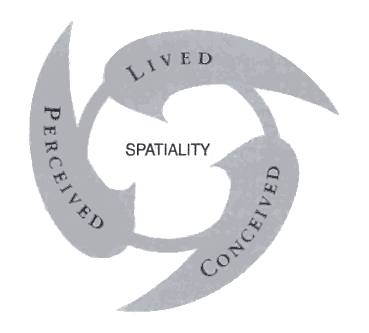
In order to understand how different people use the Archives in different ways, it is important to understand Edward Soja’s Space Theory.
According to Soja, perceived space is typically seen as the physical reality. It includes buildings and objects that simply exist as they are. The actual aspects and physical components of buildings and spaces are part of perceived space. Conceived space includes the ideas one holds about a particular location, which may override the realities of the space. For example, many people picture Pittsburgh as a smoky old steel town, even today, which overrides the reality that it is a beautiful and mostly clean place to live. Finally, there is lived space, which is the post important in considering the Archives. Lived space is how one actually interacts with a space, and how that space affects them. In the case of the Archives, since there are many different categories, there are many different ways people can interact with the space.
One important way people have used the Archives’ vast material is to plan drilling, building, and fracking projects. The Archives are home to the mining maps of Western Pennsylvania, which show all the dimensions of mining sites around Pittsburgh. These maps are extremely useful when considering the safety and logistics of any projects which may be near a mining site, whether it’s still in use or not. According to a 2014 article by Jason Cato for the Pittsburgh Tribune Review, this project began after a 2002 incident in which miners were trapped underground after they accidentally hit an abandoned mine shaft, which was filled with water. By knowing where mining sites are, it is less likely that a similar incident will occur, and the Archives are doing their part to help. In this case, researchers at the Archives would be experiencing it as a place where they can go to figure out the safety and logistics of their next project.
One interesting thing I learned on my trip to the Archives is that they often hold ongoing court case documents. Unsurprisingly, these documents are not able to be viewed by the general public while the case is still ongoing, but they also have older cases that have closed that can be seen by the general public. This collection would be undoubtedly interesting to anyone who is interested in law, especially since it’s not always easy to access full transcripts of court cases outside of a law school library.
Another thing the Archives have which is potentially highly beneficial for anyone whose family is from the Pittsburgh area is old censuses and employment records. By using these records, individuals have been able to begin or further research on their ancestors. The Archives have made it possible, and free, to find out more information on family members who have lived in Western Pennsylvania.
The Archives in the Digital Age
There has been a huge push in many industries in the new millennium to shift towards putting their resources online in order to make it easier for people who would like to access them. The Archives are no stranger to this task. Through their website “Historic Pittsburgh”, The Archives have made over 1,000 texts and over 30,000 images available for anyone to view online.
While not anywhere near all of the Archives’ contents are published online, they are still showing dedication to making their collections more accessible to those who may not be in the area.
Another way the Archives have increased their online visibility is through their Tumblr page. Tumblr, a short-form blogging website in which posts can be easily shared, is an increasingly popular way for businesses and organizations to connect with a younger audience on social media. The Archives use their Tumblr primarily to share focused posts about various aspects of Pittsburgh’s history including bridges, buildings, women’s history, and communities. These posts are often relatively short in nature, and can be used to drum up some interest in visiting the Archives in person to learn more. They also share various personal anecdotes from their staff on how they interact with the Archives.
In a 2014 study published by the Archives Service Center regarding the impact of their digitization, specifically on Wikipedia, they found that after increasing information on Wikipedia articles to link back to their sources, there was an increase in hits to those sources. This is very significant because it shows the importance of making materials widely available: researchers were able to access quality sources they otherwise might not have thought about. This also has implications for the Archives themselves, after the Wikipedia increase, there was also an increase in email inquiries to the Archives. Although they did not record whether or not there was an increase in visitors, it is not far-fetched to imagine that this digitization can help spark interest in visiting the Archives, especially for those who may not have known about it.
Who should visit the Archives?
As mentioned before, the Archives are open to anyone, not just students. I would highly recommend the Archives to anyone with an interest in any aspect of Pittsburgh’s history. Whether it’s maps, photographs, documents, or films, they truly have something for everyone. They collect their materials from businesses, religious groups, individuals, governments, museums, and many more. Their collection is very diverse and is certainly worth checking out.
However, as mentioned before, there restrictions as to what can actually enter the reading room in order to protect these rare materials. They do have spaces where visitors can have snacks or drink, but materials are not permitted to be in these spaces. It is also probably not recommended to bring young children to the Archives, as they might not be as careful with the materials.
Works Cited
“Archives Service Center @ Pitt.” Archives Service Center @ Pitt. Web.
Batz Jr., Ben. “Urban Explorers Dare to Investigate Seldom-seen Pittsburgh Sites.” Post-Gazette. PG Publishing Co.: Pittsburgh, Sep 7, 2003. Web. Accessed 1 Dec. 2016.
Bell, Thomas. Out of this Furnace. University of Pittsburgh Press: Pittsburgh, 1941. Print.
Cato, Jason. “Project Seeks to Preserve State’s Original Maps of Mines.” TribLIVE.com. 01 Mar. 2014.
Galloway, Ed, & Cassandra DellaCorte. “Increasing the Discoverability of Digital Collections Using Wikipedia: The Pitt Experience.” Pennsylvania Libraries: Research & Practice [Online], 2.1 (2014): 84-96. Web. Accessed 27 Apr. 2016.
Raap, Tony. “Pitt Library Plays Role in ‘Happy Birthday to You’ Lawsuit.” TribLIVE.com. 23 Sept. 2015. Web.
Soja, Edward W. Thirdspace: Journeys to Los Angeles and Other Real-and-imagined Places. Cambridge, MA: Blackwell, 1996. Print.
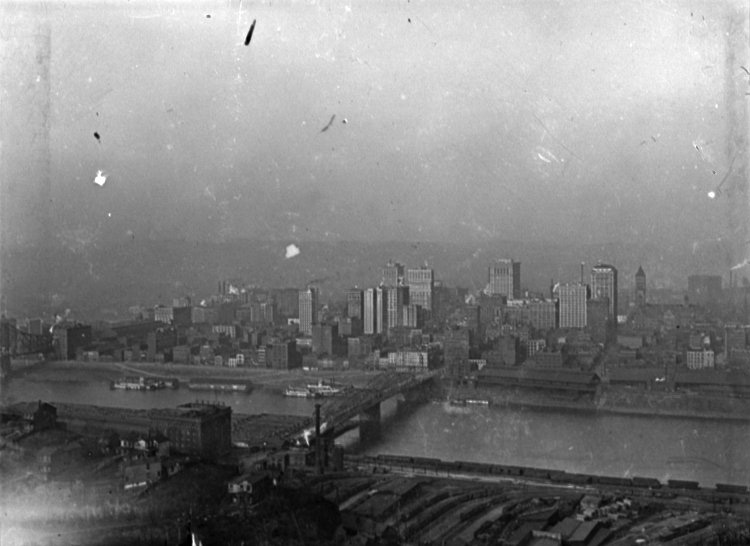
Wolf, William H. Smithfield Street Bridge. 1890-1920. William H. Wolf Photograph Collection, Pittsburgh, PA. Historic Pittsburgh.
Bell, Thomas, and David P. Demarest. Out of This Furnance. Pittsburgh: Univ of Pittsburgh Pr., 1979. Print.
Dickerson, Dennis C. Black Steelworkers in Western Pennsylvania, 1915-1950. 1978. Print.
Tate, John M., Jr. The Harmony Society at Economy Penna. 1925. Print
Gottlieb, Peter. Making Their Own Way: Southern Blacks’ Migration to Pittsburgh, 1916-30 (Blacks in the New World).U of Illinois, 1996. Print
“Who We Are.” National Urban League. Accessed 22 Oct. 2016.