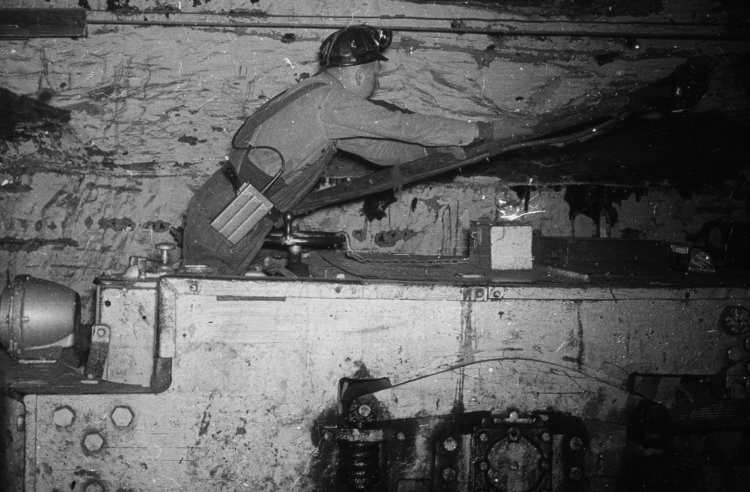
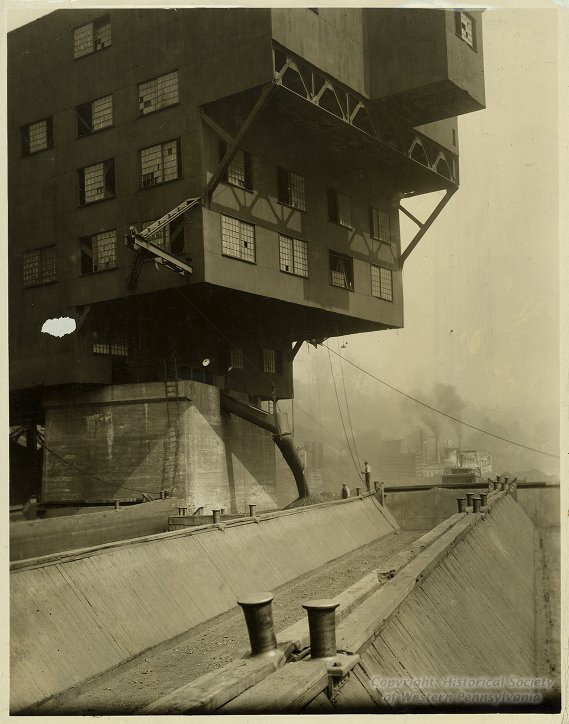
“Coal Mining”: View of a miner working inside the tunnel. Jones & Laughlin Steel Corporation, Vesta Division, ca. 1940-9. ASC Identifier 9116.333.CL
Dive through the Archive Service Center
While the Archive Service Center itself has a complex history, one of its most intriguing qualities is how it functions as a gateway into the history of the city of Pittsburgh. Through images, texts, and maps submitted by large corporations and individuals alike, the ASC helps to draw a story for its audience of what is important to the city of Pittsburgh and its residents. One large collection at the Archive Resource Center is that of maps and images of the coal mines that were once prominent in Pittsburgh and the surrounding region. Now, most of the mines are closed, no longer accessible. Many of the pictures owned previously by the corporations and the people who worked for them have made their way into the archives, to serve as a record of the lives of the coal mines and their workers. The coal mines – along with steel mills – are a defining factor in Pittsburgh’s history, and they contribute very much to what made Pittsburgh the city it is today.
The image in Figure 1, taken in an unknown location, shows an average miner working inside a tunnel. It is a simple image, though at the same time it is also very complex. It allows the viewer a glimpse into the daily life of a mine worker in industrial Pittsburgh. It shows the large machinery the miners worked with, the darkness of the inside of the mine, and to an extent the dirt and soot encountered working in the mine. In his theory of space, Edward Soja proposed the idea of lived space – as an addition to perceived and conceived space. What this means is that space is not only made up of physical elements and conceptual elements, but also an aspect that incorporates the experiences of anyone who has ever come into contact with the environment. The Archive Service Center and its collections help to pump life – lived space – into many otherwise dormant spaces. Figure 2 shows the loading of steel barges, used to transport coal from mines to mills. The large building is a tipple, which is a structure used to load coal from the mines onto the transport cars. While this particular image is not in Pittsburgh, but rather slightly south of it, tipples just like it could be seen all along the Monongahela River at the height of industry in Pittsburgh, and barges – the large boats which transport the coal – could be seen travelling from mines to mill sites riverside throughout the city.
Now, the coal mines – and steel mills, and many other fields of industry – are not as prominent in the area. As you go out further away from Pittsburgh, you can still find active and sometimes even inactive mines, though many close to the city have been sealed off. With changes in environmental regulations in recent years and an increase in cost to produce such products within the United States, much of this work has been outsourced to other countries. Pittsburgh is no longer the industrial mecca it once was. In Out of this Furnace, a novel which follows three generations of a family of immigrants from Hungary who came to America and worked in the steel mills, author Thomas Bell states,
“American industry, for all its boasting, was still crude and wasteful in its methods; and part of the cost of its education, – of that technique it was, in time, to consider, somewhat smugly, as a uniquely American heritage, a gift of God to the corporations of America, – was the lives and bodies of thousands of its workers” (47)
While he was referring to the mills in his comment, the same rings true of mining – the job was difficult and often unpleasant for its workers, but it brought in a stable income and the people who worked in these industries were proud of their work and the bonds formed with other miners they met while working. Keeping a record of these times helps to keep alive the experiences of these workers, and pass down their stories for generations to come.
Many people in today’s younger generations did not grow up experiencing these locations the same way their parents did. Kids in Pittsburgh now have grown up hearing stories of Andrew Carnegie, Henry Clay Frick, and other leaders of industry, or maybe they’ve grown up hearing of a family member or neighbor recounting their days working in the mills, or in the mines. The Archive Service Center brings these places and memories to life for a new generation who never got to experience them. Alternatively, urbexing allows for people to view these sites in a physical way. Urban exploration, often called urbexing for short, refers to exploring into abandoned locations, sometimes even inside buildings or other man-made infrastructure, to get a personal look at a site’s ruins. Though urbexing often encroaches on legal boundaries, it allows you to get a firsthand experience of the space, physical, conceived, and lived, and draw your own experience into the history of that site. In 2003, the Post-Gazette documented a group of kids exploring, among other places, the Newfield Mine, which sits along Plum Creek in Verona, an area adjacent to Pittsburgh. In a way similar but also not, the group is exploring the history of the mine as would the Archive Service Center – looking at what’s around, observing documents, memories.
The brick buildings appear bombed out — the handiwork of dedicated vandals. Robinson crouches near a crude fire ring and sifts through a mound of papers, which on closer inspection turn out to be mine records. He reads off the dates — 1973, 1971. Here’s a pay stub from Nov. 30, 1969, when a miner named Ludwig earned $242.34. Robinson lifts one of the yellowed slips to his nose and announces, ‘Ah, smell it: The smell of urban exploring!’ (Batz)
Click here to see a blog with images from the area around the former Newfield Mine, ca. 2013.
Works Cited
“Archives Service Center @ Pitt.” Archives Service Center @ Pitt.
Batz Jr., Ben. “Urban Explorers Dare to Investigate Seldom-seen Pittsburgh Sites.” Post-Gazette. PG Publishing Co.: Pittsburgh, Sep 7, 2003. Web. Accessed 1 Dec. 2016.
Bell, Thomas. Out of this Furnace. University of Pittsburgh Press: Pittsburgh, 1941. Print.
Cato, Jason. “Project Seeks to Preserve State’s Original Maps of Mines.” TribLIVE.com. 01 Mar. 2014.
Galloway, Ed, & Cassandra DellaCorte. “Increasing the Discoverability of Digital Collections Using Wikipedia: The Pitt Experience.” Pennsylvania Libraries: Research & Practice [Online], 2.1 (2014): 84-96. Web. 27 Apr. 2016
Raap, Tony. “Pitt Library Plays Role in ‘Happy Birthday to You’ Lawsuit.” TribLIVE.com. 23 Sept. 2015.
Soja, Edward W. Thirdspace: Journeys to Los Angeles and Other Real-and-imagined Places. Cambridge, MA: Blackwell, 1996. Print.
Wolf, William H. Smithfield Street Bridge. 1890-1920. William H. Wolf Photograph Collection, Pittsburgh, PA. Historic Pittsburgh.
Bell, Thomas, and David P. Demarest. Out of This Furnance. Pittsburgh: Univ of Pittsburgh Pr., 1979. Print.
Dickerson, Dennis C. Black Steelworkers in Western Pennsylvania, 1915-1950. 1978. Print.
Tate, John M., Jr. The Harmony Society at Economy Penna. 1925. Print
Gottlieb, Peter. Making Their Own Way: Southern Blacks’ Migration to Pittsburgh, 1916-30 (Blacks in the New World).U of Illinois, 1996. Print
“Who We Are.” National Urban League. Accessed 22 Oct. 2016.