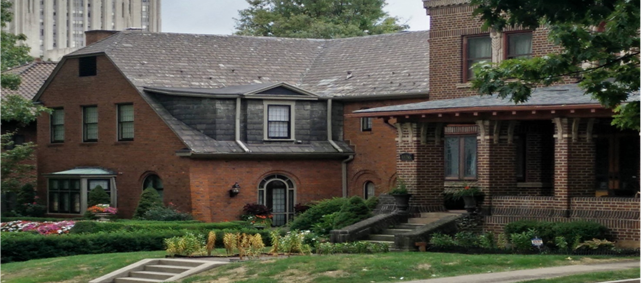
A Tudor-style cottage built in 1918, found at 4142 Bigelow Boulevard. Photo by Andrew Ryan.
A Historic District with a Religious History
Pittsburgh loses its sense of urbanism as one follows Bigelow Boulevard into the Schenley Farms Historic District in North Oakland. As you enter, you are withdrawn from the familiar concrete city structures and transported to a quaint neighborhood filled with revivalist homes and at its northeast corner, a mosque. The revivalist homes range in style from Tudor cottages to stuccoed Italian villas. One home was even built for the acclaimed entertainer and Pittsburgher Mr. Rogers’ grandparents!
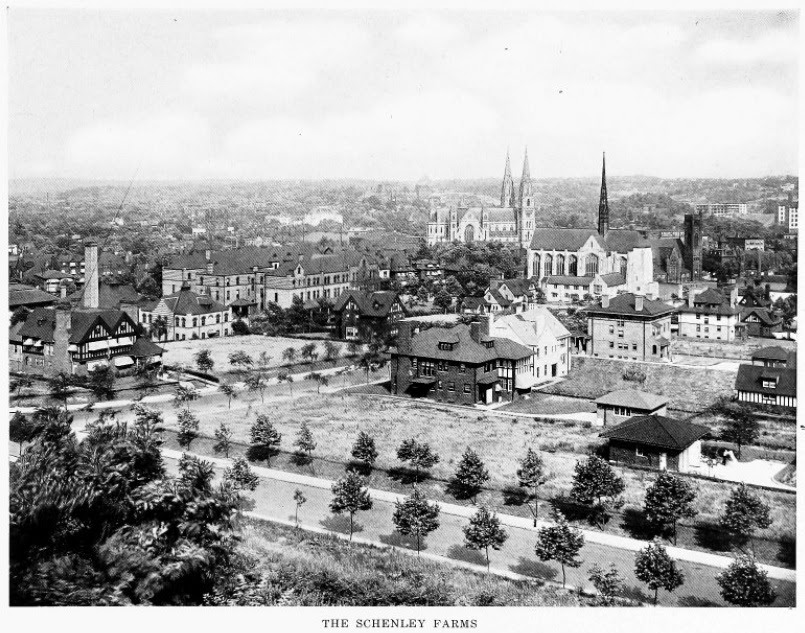
Schenley Farms Historic District was conceptualized in 1905 by Franklin Nicola as a “residential enclave adjoining a monumental civic complex, a combination of model suburb and City Beautiful [design]” (Schenley Farms Historic District). With many of the houses being built in the 1910s, this century old neighborhood is listed on the National Register of Historic Places, a result following the demolition of four large homes (“History”).
Almost a cousin of Schenley Farms is Schenley Farms Terrace, just north of the neighborhood’s borders. These still beautiful homes were originally designed for lower level business managers who could not afford the homes in Schenley Farms proper. Professional single women would often live in these homes. However, due to their unmarried status, many banks would refuse them service, resulting in the homes generally being paid for in cash or through male friends (Preservation Pittsburgh).
Nearby Sites
Readers familiar with the Sundance winning film, Me and Earl and the Dying Girl, may be excited to find out that much of the filming took place at the nearby Schenley High School, found where Bigelow Boulevard meets Center Avenue. The film, based off of the identically titled novel and written by Pittsburgh native, Jesse Andrews, details the story of a high schooler who befriends a classmate who has been diagnosed with cancer.
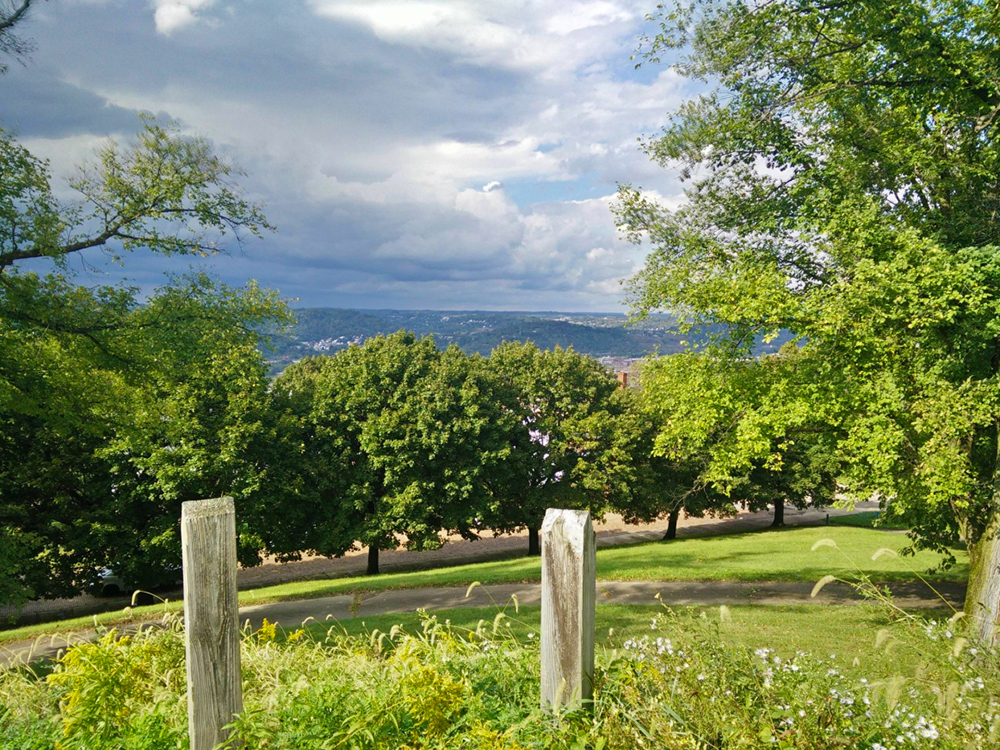
If you are looking for a spectacular view and are prepared for a small hike, check out the Robert E Williams Memorial Park north of Schenley Farms. While there are the normal park amenities such as a basketball net and water fountain, the real draw is the view of the city skyline from atop the the reservoir in the middle of the park.
An interesting, but unfortunately closed to the public site in the Schenley Farms neighborhood is the Oculus Rift research center, located where Bigelow Boulevard becomes Bayard street. Oculus develops personal headsets that allow users to experience virtual reality.
A History of Schenley Farms’ Religious Space
The location where the Islamic center resides has a history as a religious space before the Islamic Center moved in in the early 1990s. Before the location was run by the Islamic Center, it was called the Kingdom Ministry School for Watchtower’s Elders and used by Jehovah’s Witnesses. Pittsburgh has a personal history with the Watchtower Society starting in the 1870s when Charles Taze Russell, born in Allegheny City (today Pittsburgh’s Northside,) founded the religion. The Kingdom Ministry School for Watchtower’s Elders was run by a man named Albert Schroeder from 1968 until 1974 when he was promoted to a higher position in the church.
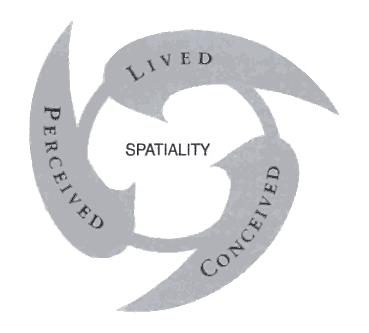
The religious history of the location leads to an interesting analysis using Soja’s Theory of Space. Soja describes a trialectic space, consisting of perceived, conceived, and lived space. The perceived space of the Islamic Center is the building. Looking at it, it is rectangular, with no dome or minaret, calling back to its construction as a place of worship for Jehovah’s Witnesses.
Conceived space describes a person’s imaginings of the place. This includes how you see the Islamic Center fitting in with the Schenley Farms neighborhood. Does it add to the cultural diversity that the revivalist homes seem to strive for, or does a place of worship in an otherwise residential neighborhood seem out of place?
Lived space acts as a combination of perceived and conceived space, and can be seen in the worship space that is used by the Islamic Center. While there is a physical component to it, the worship space is also a mental space for the congregation.
Throughout its history, 4100 Bigelow Boulevard has been adding diversity to the Schenley Farms neighborhood.
“God speaks directly to human beings, proclaiming that humankind was created from a single pair of male and female and made into different peoples and ethnicities so that they might come to know each other.” – Edward E. Curtis
Pitt Muslim Student Association
The Pitt Muslim Student Association has a long history with the Islamic Center of Pittsburgh. They helped to raise the funds that allowed the Islamic Center to move to its Bigelow Boulevard location.
The Pitt MSA’s mission statement is:
“to serve the interests of Muslim students at Pitt so as to enable them to practice Islam as a complete way of life. Pitt MSA plans Islamic activities, community service projects, and various events in order to strengthen relations and understanding between Muslims and people of other faiths.”
The Pitt MSA puts on numerous events throughout the year to build community and break misconceptions. Events include Fast-A-Thon, an event where students fast for a day, then gather together for speakers presenting about humanitarian efforts. At sundown, participants enjoy a free, delicious catered dinner. Money is raised to help donate clothes and books to those in need.
Recently the Pitt MSA put on a series of events for Islam Awareness Week, including an event about breaking stereotypes that made ThePittNews. At the event, people would write a stereotype of themselves on a wooden board after which they could symbolically break that stereotype. Another event during Islam Awareness Week was the Hijab Challenge where participants were taught how put on a hijab and could then “be in someone else’s shoes” for a day.
Works Cited
Curtis, Edward E. Muslims in America: A Short History. Oxford: Oxford UP, 2009. Print.
“History.” Schenley Farms Historic District. N.p., n.d. Web.
“Home.” The Islamic Center of Pittsburgh. N.p., n.d. Web.
Preservation Pittsburgh. Schenley Farms House Tour, 1997. N.p.: Preservation Pittsburgh, n.d. Print. Visit http://www.schenleyfarms.org/links.html for link to brochure
“Schenley Farms Historic District.” Living Places. The Gombach Group, n.d. Web.
Historic images located in interactive map by Jonathan Daniel