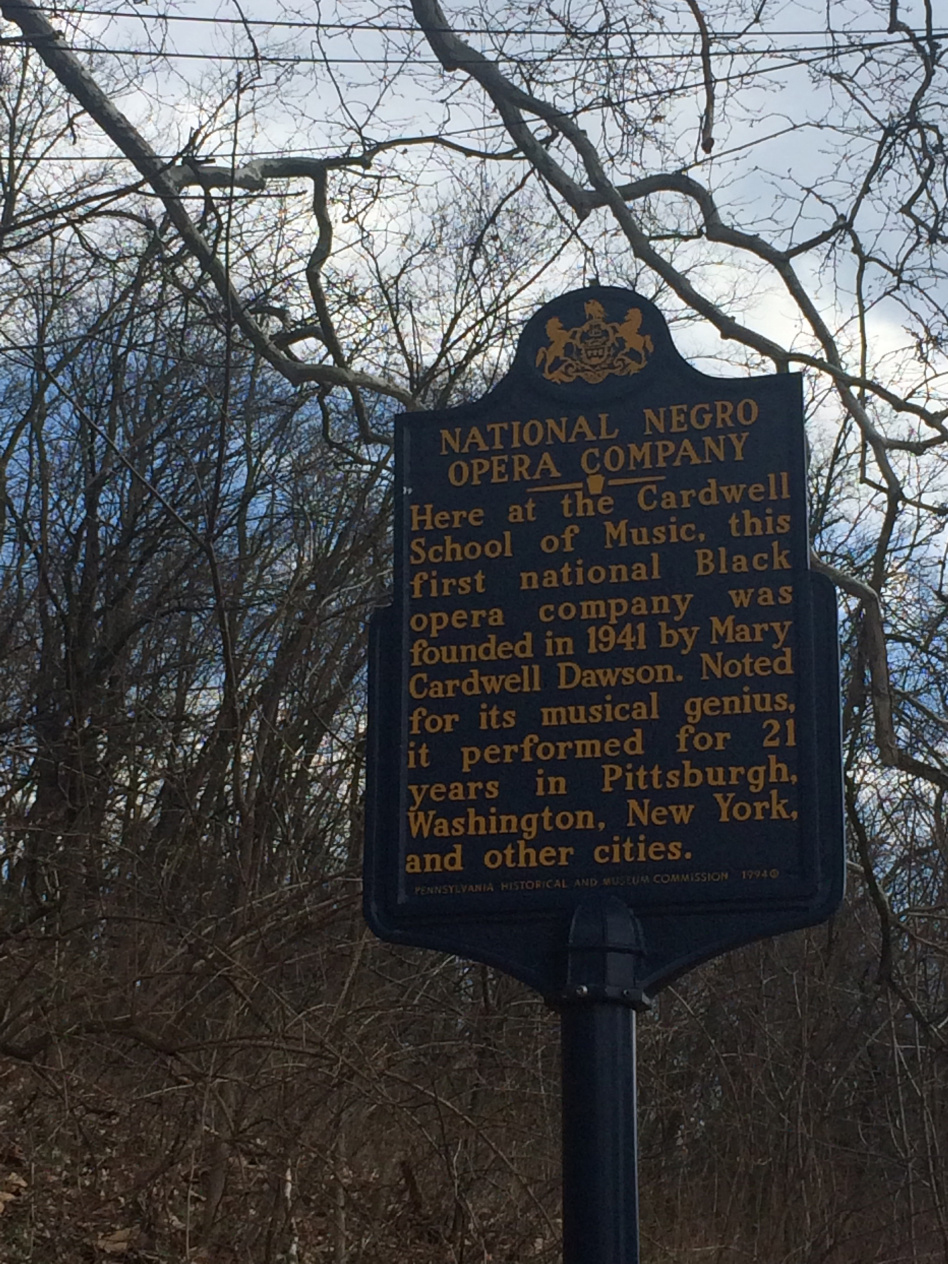
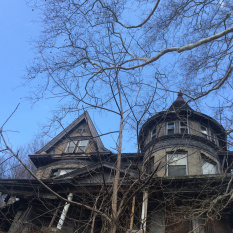
Sign about National Negro Opera House.
What if the National Negro Opera walls could talk?
In his writing, Edward Soja speaks about how spaces can have importance as a result of its “historicality” and what Soja calls thirdspace, which is “combining the real and the imagined, things and thought on equal terms…these lived spaces of representation are thus the terrain for the generation of ‘counterspaces,’ spaces of resistance of the dominant order arising precisely from their subordinate, peripheral or marginalized positioning.” I’ve used this quote as inspiration for my poem “The Walls Tale.” During my research of the National Negro Opera House I came across a video of its former occupants. Many of them told great stories about the house that brought the place back to life in the viewer’s mind. Though the Opera House is worn and torn, it nonetheless lives through its “historicality.” As the former occupants said: “if only the walls could talk.” Thus, I thought I would address the question of “what if the walls did talk?”
I seek to answer this question through my poetry to help tell the tale of what the walls once saw. The walls have housed so many stories that should be told. My poetry serves to be a glimpse into gaining greater understanding of the “lived” aspects that Soja speaks of. I believe that poetry, a very fluid and creative approach to history can help inspire readers to see the house for more than what it is today.
During my research I found out that the National Negro Opera House was the location of the first Black National Opera Company in the nation. I also found out that great athletes like Roberto Clemente lived in the house. And, that one night ownership of the Steelers was bet on. There are so many stories that the walls of this house could tell. And though I may not have seen many of these occurrences, I sought to recreate them through my poetry and to further emphasize the importance of preserving such a historically significant landmark.
The history of the National Negro Opera House begun when Woogie Harris, the brother of famous photographer Teenie Harris, bought the house in the 1930s. At the time, the house was located in Homewood, a neighborhood that was for the most part middle class and white and white. By 1941, the house on Apple ave. became the headquarters and audition studios of the National Negro Opera Company. The company became hugely successful following a performance of Aida at the Syria Mosque. The Syria Mosque was torn down in 1994, due to a widely disputed deal with UPMC that resulted in the arrest of Former Senator Jim Ferlo. Though the situation of the Syria Mosque is different than that of the National Negro Opera House I can’t help but draw parallels. The Syria Mosque was demolished despite historically relevant performances. The acoustics of the venue have been described to me as “impeccable” and “amazing” with looks of nostalgia and remorse. Such sentiments mirror much of what the former occupants of the National Negro Opera House feel. In a current state of disrepair, the National Negro Opera House once rang with songs of its own.
Despite national acclaim, Mary Cardwell Dawson suffered from financial insecurity. The Pittsburgh Courier at the time lamented about this when it wrote: “How easy it would be for one of the many foundations in Pittsburgh to underwrite such an effort as hers with a yearly grant of $10,000. Such a grant would allow her to eradicate quickly all imperfections. This would be a cheap price to pay, for a few years, for what Mrs. Dawson can contribute to our cultural renaissance.”
Though such a yearly grant was never awarded to Mrs. Dawson, the Young Preservationists Association of Pittsburgh hopes to further recognize Mrs. Dawson’s contributions to Pittsburgh’s “cultural renaissance.” Dan Holland the founder of the Young Preservationists Association of Pittsburgh (YPA) says that the National Negro Opera House is among many other structures of Pittsburgh’s black history that have been disappearing at alarming rates. In order to address this issue the YPA hopes to raise funds and turn the house into a community center. The YPA hopes that the house will once again be filled with the same artistic spirit that coursed through its halls when Mrs. Dawson’s National Negro Opera Company was headquartered on Apple ave.
The Wall’s Tale
If only the walls could talk, they said.
Years and years later
the house had withered away from the wear and tear of the dark steel
dusted air.
The house,
a beacon of (an underrepresented)
black culture,
Had grown tired and weary.
The rain washed its shutters shy.
The wind had weathered its windows.
And the people had forgotten
Of the house
With a tale to tell.—
The walls came up in 1908
But the Numbers man
Knocked the fourth wall down
in ‘41
The house was big
On a hill it sat
On the top people sang
On the bottom the dimes piled
The nickles shook
And called the people
in.People knew Woogie Harris
He played the numbers
Dimes stacked to touch the tip
Of the tiles
At the tip of the roof
Numbers would bring
The crowds in
Bets were placed
all in good game.But one evening the game got funny
Black and Yellow made it to the table
And Rooney wanted to bet
Woogie was a good man
He’d help a friend out
He’d keep a game going
He’d keep the story rolling
Till the walls could hearBut Woogie knew that luck
Was whimsy
“Take another turn–on me.”
The walls listened closely
Rooney leaned in
The numbers rattled
The men crawled closer
The whispers got louder
Till the numbers
turned the nickel
Black and Yellow—
In the Mosque from Syria
A woman once sung
To Aida
The crowd fell in love
With the Nubian princessIn the Mosque
The notes of art
Soared into the acoustic nooks
The walls pushed their roots firmly into the earth
And grew out with each noteThe staccato of the drum roll
Lined the streets
The roots held firm
In anticipation of a coda
But was met with a double
Bar lineThe roots were pulled
To sow seeds of gravel
The lines were drawn
The carriages were parked
The home of good song
Was silenced—
Till 1962 the walls stood up for Mary
They hugged her company in
The walls listened
To the the tunes that turned
To the dimes that dancedThe walls watched
The walls wept
When the songs grew silent
And the dances grew dim.The walls stood tall
They crept closer
Slowly and slowlyThey stood
strong,
firm.
For as long as they could
They stoodBut the walls wept
As the songs grew silent
And the only singing it heard–
Came from the wind
That whistled the
wood till it was as thin
As thinned gin.—
The walls droop down to the ground
The trees have grown over
The racoon has taken shelter
And the house has become historic
Though some may say it’s prehistoricBut the walls watch and wait
After its shutters were shunned
Its windows wilted
After Woogie grew daisies
And Rooney grew rich
But the walls will waitOn 7101 Apple street
A home in Homewood
The Queen Annne-style house
Stood once more
Inside children played music
Brushstrokes of color
Painted the wallsSoja would smile
To see the lived
Come back to the house
Of historySoja once spoke of
combining
Real and imagined things–
Thought on equal terms
Lived spaces
Representation
Terrain for generation
Of CounterspacesThe Syria Mosque has fallen
The National Negro Opera House
Remains wilted
The real and the Imagined can come
On equal terms
In a lived space
To represent
Once more
A Terrain for a generation
Of Counterspaces
Works Cited
Glasco, Laurence Admiral, and Federal Writers’ Project (Pa.). The WPA History of the Negro in Pittsburgh. Pittsburgh: University of Pittsburgh Press, 2004. Web.
Hamill, Sean. “Two Decades Later, Razing of Syria Mosque Still a Sore Topic.” Pittsburgh Post-Gazette. N.p., n.d. Accessed 10 Mar. 2016.
Jones, Diana Nelson. “Preservationists Hope Plaque Is First Step toward Rebirth of Storied Homewood House.” 2 May 2007. Accessed 16 April 2016.
Jones, Diana Nelson. “An Irrepressible Voice.” Pittsburgh Post-Gazette. N.p., 1 Aug. 1999. http://old.post-gazette.com/magazine/19990801opera1.asp>. Accessed 4 Mar. 2016.
Paradise, Jack L. “Mosque Editorial Triply Wrong.” Letter to the Editor. The Pittsburgh Post-Gazette. 11 July 1991.
Ruck, Rob. Sandlot Seasons: Sport in Black Pittsburgh. Illini Books ed. Urbana: University of Illinois Press, 1993. Web.
Soja, Edward. Thirdspace: Journeys to Lost Angeles and Other Real-and-Imagined Places. Cambridge MA: Blackwell Publishing Inc., 1996.
Spears, Charles. “La Julia Rhea Gets Singular Recognition.” Pittsburgh Courier, 30 Oct. 1937: Print.
“Syria Mosque.” Pittsburgh Music History. N.p., n.d. https://sites.google.com/site/pittsburghmusichistory/pittsburgh-music-story/venues/syria-mosque>. Accessed 4 Mar. 2016.
The National Negro Opera Company Collection 69.1019 (1993): 36. Special Collections in the Music Division of the Library of Congress. Web.
Trotter, Joe W., and Day, Jared N.. Race and Renaissance : African Americans in Pittsburgh since World War II. Pittsburgh, PA, USA: University of Pittsburgh Press, 2010. ProQuest ebrary. Accessed. 13 March 2016.
Verdi, Giuseppe, and Antonio Ghislanzoni. Aida: An Opera, in Four Acts. New York: C.E. Burden, 1900.